
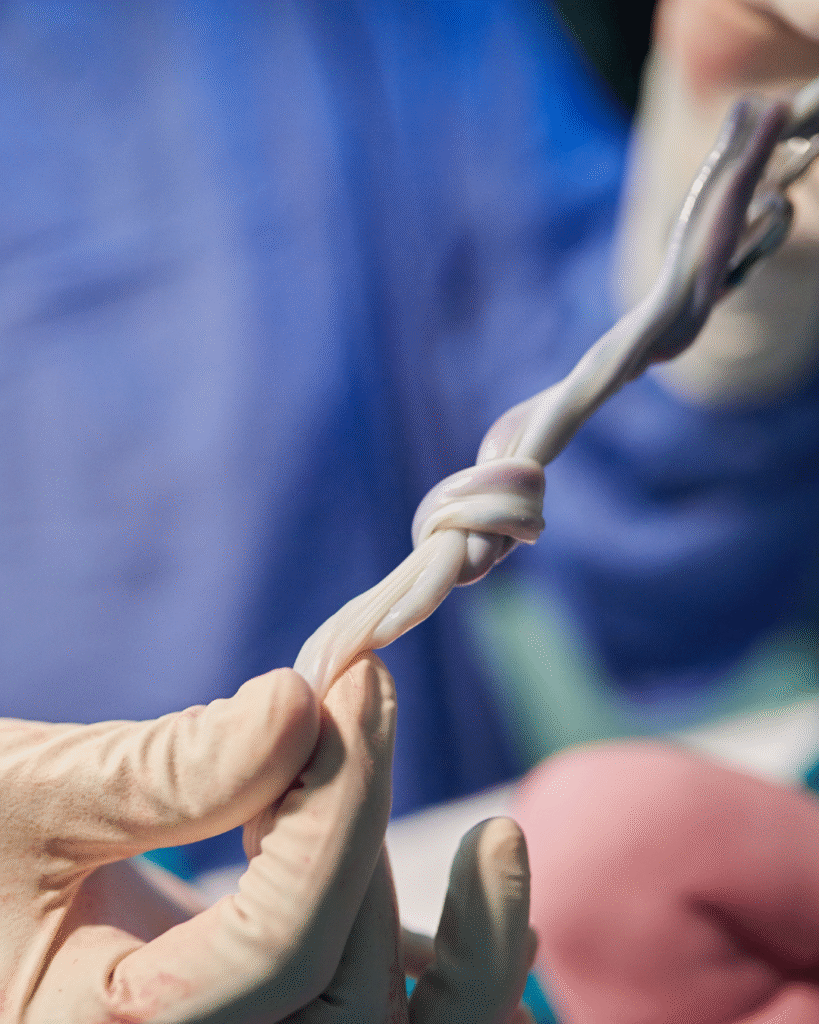
If you are currently pregnant, you have probably heard of delayed cord clamping. If you are not completely sure what it is, this article will explain the process and its benefits.
Firstly, let’s go back to some old school anatomy. If you are currently pregnant, your baby is inside your womb and is connected to the placenta by the umbilical cord. When your baby is born, we aim for them to be delivered straight onto your skin. The benefits of skin to skin and why midwives love talking about it so much can be found in my next article. When your baby is born, they will still be attached to the placenta via the cord. Your placenta will then be born on average around 10 minutes after your baby, signifying that the labour and birth is ‘complete’.
The recommended timing of when to cut the cord has changed in recent years thanks to growing medical evidence that indicates ‘delaying’ the cord being cut (more than one minute after the birth is generally considered delayed however for the cord to be fully drained of blood takes longer) has a number of benefits to your baby.
Increased iron stores
Your baby will receive more blood if delayed cord clamping occurs, which increases haemoglobin levels. By receiving more red blood cells, iron stores are improved for the first several months of your baby’s life, thereby reducing the risk of anaemia. Increased blood supply at birth enables optimal brain development and developmental outcomes are more favourable.
Increased stem cells
The cord blood also contains lots of stem cells which helps your baby to grow and supports their immune system. Stem cells also play a vital role in repairing damaged tissues. This is particularly significant if your baby is born premature.
Benefits if your baby is born premature
If your baby is born before 37 weeks gestation (therefore considered premature), delayed cord clamping is just as beneficial and can be argued is even MORE important. It may be more likely that your baby might require breathing support when they are born as they adapt to life outside the womb; however delayed cord clamping should not be disregarded based on this alone. Studies have shown that when the cord was cut at least one minute after the birth (with preterm babies who did not require resuscitation), incidences of anaemia, bleeding on the brain and severe gastrointestinal illnesses were reduced. Once again this is thanks to the increased blood supply that your baby will receive.
Delayed cord clamping and jaundice
Some clinicians advise against delayed cord clamping because it can supposedly lead to increased rates of jaundice. Physiological jaundice is a normal occurrence categorised by yellowing of the skin, most commonly on your baby’s chest and face. 60-70% of term babies will develop jaundice around day 3-5 thanks to the increased bilirubin levels that need to be excreted out in their poo (this is why those first poos are black and sticky!). Only a small proportion of these baby’s require treatment for jaundice- this would be assessed by their behaviour as well as bilirubin levels in their blood. Jaundice is treated by special blue phototherapy lights which help to break down the bilirubin. The number of babies who require phototherapy varies due to different countries using different parameters for when treatment levels. The link between delayed cord clamping and jaundice has however been refuted and no significant difference has been found in treatment rates. The benefits of delayed cord clamping are evidenced based and as the statistics show above, many babies develop jaundice without needing treatment which is a normal physiological response.
Can I have delayed cord clamping if I have a caesarean?
No matter what your obstetrician may tell you- the answer is yes! Whilst your baby cannot be delivered straight onto your skin (due to the theatre equipment and the need to maintain a sterile environment), one minute of delayed cord clamping can still be possible. Whilst the cord may not be fully drained at one minute, your baby will still get the benefits which are immense. Once the cord is cut, your baby can then be bought to you for skin to skin- there is no need to wait.
When delayed cord clamping might not be recommended
Sometimes, babies enter the world shocked and may require some stimulation to help them to start breathing by themselves. Midwives can easily rub them with a warm towel which stimulates them to breathe. The benefits of leaving your baby attached to the cord whilst this stimulation happens is well documented in research. The majority of baby’s will start to breathe for themselves within 60 seconds, therefore if we cut the cord too soon, your baby will miss out on the positive effects of delayed cord clamping as already described above. However if your baby is born and appears that they are making no effort to breathe for themselves, your midwife/obstetrician may deem it necessary to cut the cord immediately after the birth. This is to ensure that there is no delay in giving them the support they require.
Delayed cord clamping is not shown to increase the risk of you losing a larger than normal amount of blood after the birth. In very rare occurrences, few women do bleed heavily immediately after the baby is born. In this scenario, it would be recommended to cut the cord straight away so that the placenta can be born, enabling drugs to be given which will help the uterus to contract (which should then reduce bleeding).
Can my birth partner still cut the cord if I have delayed cord clamping?
Yes that is possible- be sure to make sure that your midwife/obstetrician is aware of this request.
Should I write on my birth plan that I would like delayed cord clamping?
Whilst it should now be universal practice to offer delayed cord clamping to all women, it may not be as standard practice in some countries/systems. We would therefore recommend that you document your preferences with your midwife/obstetrician when you discuss your birth plan with them around 36 weeks, as well as the team caring for you on the day that you give birth.
What if delayed cord clamping doesn’t happen?
Sometimes, due to some of the reasons discussed above, delayed cord clamping might not be possible. As with any birth preference that doesn’t go how you planned, this can feel disappointing. Firstly, don’t panic- whilst delayed cord clamping has many benefits, a healthy, term baby has all it needs to adapt to life outside the womb. Be sure to have lots of skin to skin time with your baby as soon as possible which will help to calm them, keep them warm and help with bonding.
Unsure what to write on your birth plan or hearing conflicting things about what might be best? The Beloved Bumps midwives are here to support you and provide a safe space to discuss the most up to date evidenced based advice, enabling you to make fully informed decisions. We love to support families in writing their birth preferences, meeting you at a time and a place which is most convenient for you. Check out the ‘midwife consultation’ tab on our website to book.